Non-Imperative Network Programming
summary
Claims that full network stacks work in OCaml via MirageOS and unikernels, replacing sockets with explicit module types that expose concrete APIs (flow, TCP create_connection, callbacks). Demonstrations include a tiny TCP discard server (port 9), pluggable virtual NICs and lossy links for tests, and substitutable RNGs/clocks to speed timeouts. Surprising measurement: sysctl shows 688 tunables to the kernel. Overall the tools let teams build unikernels and predictable stacks that are easier to test and reason about.
AI-written summary · about
chapters (9)
- 0:00NON-IMPERATIVE NETWORK PROGRAMMING
- 0:15DISCLAIMERS
- 4:09SOME SOCKET FUNCTIONS
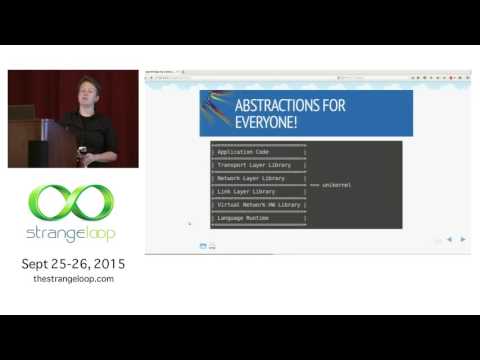
- 9:33ABSTRACTIONS FOR EVERYONE!
- 12:17IMPOSING STRUCTURE
- 17:19HOW DO WE RUN SERVERS?
- 18:51A TRIMAL SERVER
- 21:23FULL-STACK DEVELOPERS
- 27:01INSTRUMENTATION
related talks
 01h 06mCompile your own cloud with Mirage OS v2.0
 25mUnikernels and why they're useful (or not)
 07mLightning Talk: Optimizing Security Container Runtime's Network Performance with Modular Plugin TCP/IP Stack
 54mThe Linux Network Stack
 12mAutomated Synthesis of Verified Firewalls
 30mVerifying Reliable Network Components in a Distributed Separation Logic with Dep...
- 12mAutomated Synthesis of Verified Firewalls
 28m"Safety in an Unsafe World"