How machine learning helps cancer research
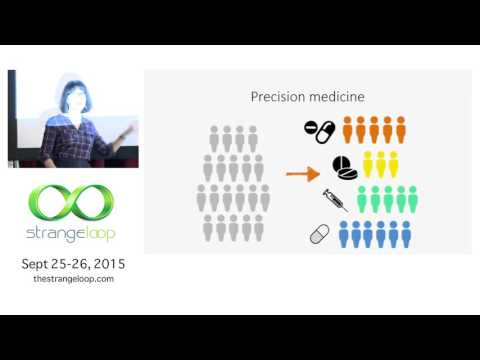
summary
Machine learning identifies concrete results: clustering of gene-expression to find cancer subtypes that correlate with treatment response and survival; matrix factorization on sparse mutation matrices to extract mutational signatures (smoking-linked C→T) and patient factors; sequencing scale and cost claims — whole human genome ~20× around the earth and down to ~$1,000 — motivate these methods. Verification tools appear as actionable wiring: F# + Z3 SMT proofs and the Biomodel Analyzer reveal that some leukemias are highly stable and require pairwise targets to destabilize.
AI-written summary · about
chapters (7)
- 0:00Introduction to DNA data
- 3:03Genetics of cancer
- 6:30Clustering for cancer
- 10:34Collaborative filtering
- 15:51Formal verification logic
- 23:52Modeling biological systems
- 30:39Conclusion
related talks
 35mFrom cells to drug responses - machine learning in cancer research
 18mCan AI make us smarter than cancer
 21mFighting Cancer with AI
 29mMachine Learning Techniques for Omics Data Analysis
 29mCancer diagnostics enabled by machines: finding and classifying single tumor....
 01h 31mIntroduction to Cancer Bioinformatics I: Inferring Genomic Variation from Tumor Sequencing Data
 20mDiagnostic Medical application of ML
 30mMachine Learning: A New Approach to Drug Discovery