Alluxio Data Orchestration for Machine Learning
summary
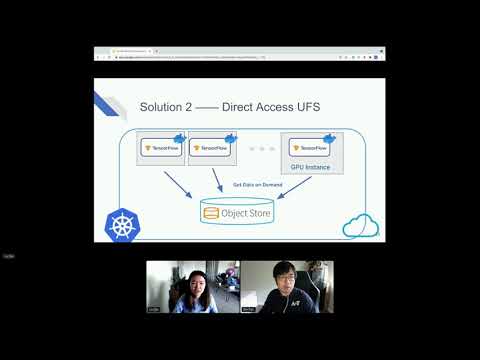
Alluxio adds a POSIX layer with a JNI-based FUSE implementation, a distributed caching layer and a distributedLoad job to prefetch datasets; engineers optimize listing and metadata for massive small-file workloads and add retries and replication for stability. Production results include 80% speedup for a Microsoft cluster with 400 jobs and >1 TB datasets, Alibaba seeing throughput jump from ~300 MB/s to up to 6 GB/s or reported 5x improvement on ImageNet-style small-file benchmarks, and multi-hundred-terabyte deployments handling billions of files.
AI-written summary · about
chapters (30)
- 0:00Intro
- 2:00Users
- 3:34Agenda
- 4:09Training
- 4:38Frostbite
- 4:50Multiple machines
- 5:31Summary
- 6:15GPU cluster
- 8:00Cloud training data solutions
- 10:33Architecture
- 11:21Posix
- 15:21Load Data
- 16:53Cached Data
- 18:39Copy Data
- 20:17Retry Mechanism
- 21:41Solution
- 22:54Use Cases
- 23:33Microsoft Case
- 26:42Alibaba Case Results
- 27:28Momo Case
- 30:07Lasso Case
- 30:48Recap
- 32:13Questions
- 32:52Roadmap
- 35:07Open Source vs Enterprise
- 37:55Collaboration
- 38:29Technical Question
- 40:32Capacity bottleneck
- 42:28Clarification
- 43:22Upcoming features
related talks
 40mOpen Source Memory Speed Virtual Distributed Storage System
 25mOvercoming I/O Bottlenecks in LLM Training with Open-Source Distributed...
 32mStreamlining Data Access for with
 35mAccelerating Spark Workloads in a Mesos Environment with Alluxio
- 25mOvercoming I/O Bottlenecks in LLM Training with Open-Source Distributed Caching
 05mLightning Talk: How to Bring Data Locality to I/O-Intensive Workloads on Kubernetes
 05m⚡ Lightning Talk: Using Decentralized File System to Optimize ML/AI Workloads on Kubernetes
 20mAdvanced CSI-FUSE Filesystem for AI/ML Data Management in Kubernetes