Virtual U: Defeating Face Liveness Detection by Building Virtual Models...

summary
Create textured 3D reconstructions from 3–27 public photos and render them as an animated face on a phone in a VR rig to match depth and motion cues; a single high‑resolution frontal photo yields 100% success with five commercial systems in lab tests for 20 subjects, while online-photo attacks succeed at 85% / 80% / 70% / 55% / 0% against KeyLemon, Mobius, TrueKey, BioID and oneU respectively; motion‑consistency classifiers confuse many VR spoofs and only hardware (IR or structured light) reliably defends.
AI-written summary · about
chapters (16)
- 0:00Intro
- 3:35Virtual U
- 4:42Online Photos
- 5:51Face Modeling
- 7:01Base Modeling
- 9:04Texture Imputation
- 9:39Correct for Eye Gaze
- 11:34Experiments
- 12:19Experimental Data
- 13:02Results
- 14:28Observations
- 17:44Motion Detection Defense
- 18:39First Experiment
- 20:00Mitigations
- 20:59Texture Detection
- 21:50Conclusion
related talks
 08mAdvancements in facial recognition
 45mYour passport to the 7th continent
 28mFace spoofing detection: theory and practice
 37mThe Living Dead: Hacking Mobile Face Recognition SDKs with Non-Deepfake Attacks
 16mThe Threat of Deepfakes to Remote Identity Verification Systems
 23mMultimodal Video Face Liveness: A Better Alternative?
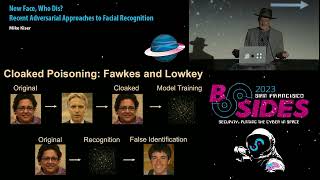 26mNew Face, Who Dis? Recent Adversarial Approaches to Facial Recognition
 40mNew Face, Who Dis? Protecting Privacy in a World of Surveillance