ICARUS: Attacking low Earth orbit satellite networks
summary
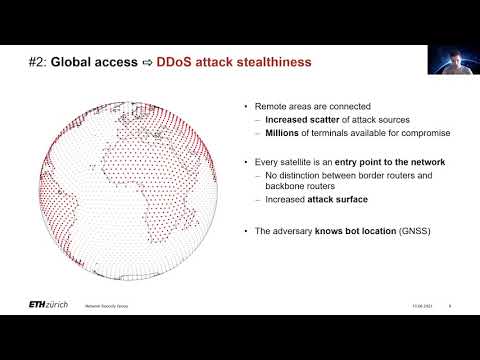
ICARUS shows a practical denial‑of‑service on LEO constellations by exploiting public orbital positions, predictable routing, and global terminal access to congest inter‑satellite links. The model uses 4 Gbps per satellite and 20 Gbps ISL capacities, a simulator (open source on GitHub), and two metrics: attack cost and detectability. For shortest‑path routing a few hundreds of bots can congest >99% of end‑to‑end paths; randomized load‑balancing raises the attacker’s cost or detectability but does not eliminate the threat.
AI-written summary · about
chapters (15)
- 0:00Intro
- 2:43SpaceX Starlink Shell 1
- 3:56The ICARUS attack
- 4:33Starting point: the Coremelt DDoS attack
- 5:26Space-based low-latency network - Predictability
- 6:28Global access - DDoS attack stealthiness
- 7:11Low-latency/higher cost - Tight operation margins
- 8:23ICARUS Attack mechanism
- 9:25Satellite routing in the paper...
- 11:06Load balancing over satellite paths
- 11:23Load balancing design space
- 12:19Load balancing effect on attacks
- 13:12Probabilistic ICARUS detectability optimization
- 13:26Mitigations
- 14:04Conclusions & Contributions
related talks
 44mAn Introduction to Cybersecurity in Space
 46mSecuring Space: The Next Frontier for Security Engineers
 11mHacking in Space
 40mHouston, We Have a Problem: Analyzing the Security of Low Earth Orbit Satellites
 48mWhy Outer Space Is the Next Frontier for Cybersecurity
 39mHack the Sky: Exploring Satellite Vulnerabilities and Cyber Threats
 31mSatellite Communications: Analyzing & Protecting Space-Based Assets
 43mThe Birdman: Hacking Cospas-Sarsat Satellites