Counterfactual Inference For Sequential Experiment Design
summary
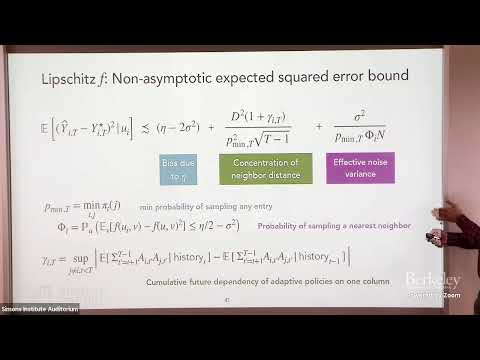
A policy-agnostic nearest-neighbor estimator treats each treatment as an N-by-T matrix and reduces counterfactuals to sequential matrix completion, proving consistency under a bilinear latent-factor model and a central limit theorem (normal fluctuations at rate sqrt(N_neighbors)) for Lipschitz nonlinearity at the final time. Requirements are lower-bounded sampling probabilities, diverse time factors, non-adversarial noise and slow adaptive changes (a small gamma term). Tuning uses cross-validation and a preprint is on arXiv.
AI-written summary · about
chapters (8)
- 0:00Introduction
- 1:23Setup
- 4:13Outline
- 7:09Reduction
- 8:17Approximation
- 10:42Latent Factor Model
- 20:30Central Limit Theorem
- 23:55Expected squared error bound
related talks
 47mCausal Matrix Completion: Applications to Offline Causal Reinforcement Learning
 33mSimple Yet Efficient Estimators For Network Causal Inference...
 29mCausal Matrix Completion
 11mCausal Inference For Socio-Economic & Engineering Systems
 49mCausal Inference in Complex Systems: Network Interference, Strategic Agents, and Beyond
 52mCausal Matrix Estimation
 39mModern Bayesian Experimental Design
 30mNon-parametric Causal Inference in Dynamic Thresholding Designs