A Robust, Differentially Private Randomized Experiment For Evaluating Online Educational...

summary
Designs a randomized experiment that injects noise with RP-RCT and a two-spinner, sample-split procedure to detect protocol deviators and still estimate causal effects. Implements a JavaScript die interface, sets epsilon=2, runs with N=78, and reports 24% cheaters; the estimator identifies the ATE among honest participants and yields higher attention when the instructor’s video is on. The privatized individual data are shareable for replication.
AI-written summary · about
chapters (18)
- 0:00Intro
- 0:49Outline
- 2:38Randomized Control Trials (RCTS)
- 3:23Problem: RCT Meets Data Privacy
- 5:00Current State of Data Privacy in RCTS
- 6:57Differential Privacy (DP) (Dwork et al. (2005))
- 8:17Differential Privacy: Formal Definition
- 8:48Example: Forced Randomized Response (FRR) Warner (1965)
- 11:30Detecting Proportion of Cheaters Via Sample Splitting and Mixed FRR (Clark and Desharnais (1998))
- 13:32Our Proposal: Robust, Private RCT (RP-RCT)
- 15:09Properties of RP-RCT: Differential Privacy
- 16:08Assumptions Under RP-RCT
- 21:37Covariate Adjusted Estimator in RP-RCT
- 22:08RP-RCT in Practice: Online Statistics Lectures at UW-Madison
- 23:59Treatment Arms in UW-Madison Trial
- 24:19Covariate Balance
- 25:57Summary
- 27:26Acknowledgements
related talks
 58mLarge-Scale Private Learning, Part III
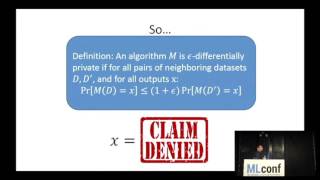 26mAaron Roth, Associate Professor, University of Pennsylvania, NYC 2017
 26mGeneralized Private Selection and Testing with High Confidence
 30mAccuracy First: Selecting a Differential Privacy Level for Accuracy-Constrained...
 20mShare data without revealing personal information
 44mDifferentially Private Inference for Regression Coefficients
 32mBLENDER: Enabling Local Search with a Hybrid Differential Privacy Model
 48mRobust Statistics and Bias Correction: Ideas for Differential Privacy and Utility