Causal Estimands And Interventions
summary
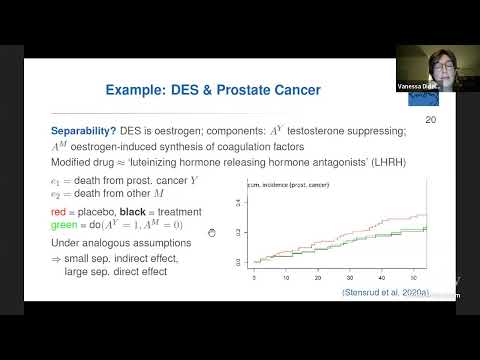
Proposes separable effects as an estimand that splits a randomized treatment into two manipulable components (one driving the disease pathway, one driving competing events or side effects), formalizes identification via an extended causal graph and the mediation g‑formula, and contrasts the observed two‑arm trial with a four‑arm hypothetical trial where components differ. Applies this to a prostate cancer trial: the estimated direct effect nearly equals the total effect while the indirect (via competing mortality) is small, under strong no‑unmeasured confounding and separability assumptions.
AI-written summary · about
chapters (7)
- 0:00Introduction to estimands
- 1:57Target trial emulation
- 5:02Challenges in randomized trials
- 9:11Concept of separable effects
- 15:01Formalizing causal models
- 20:00Application in survival settings
- 28:10Concluding remarks
related talks
 33mSimple Yet Efficient Estimators For Network Causal Inference...
 24mA Friendly Introduction To Causality
 31mA Gentle Introduction To Causal Inference
 41mOn the Path to Causal Inference
 44mCausal Reductions
 39mCausal Effect Estimation in Practice: Lessons Learned from E-commerce & Banking
 11mCausal Inference For Socio-Economic & Engineering Systems
 49mCausal Inference in Complex Systems: Network Interference, Strategic Agents, and Beyond