Complete Problems for Multi-Pseudodeterministic Computations
summary
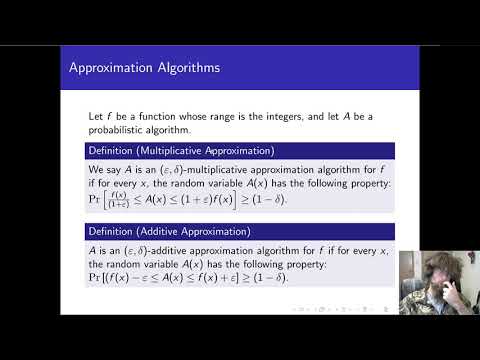
Establishes that collision probability estimation is complete for turning approximation and multi-valued search algorithms into pseudodeterministic ones: if collision estimation is pseudodeterministic (with error small enough) then any constant-factor multi-pseudodeterministic algorithm becomes pseudodeterministic. Builds a selector that runs two strategies, estimates collisions, and uses a 34/64 threshold (bounds like 9/16 and 1/2+2ε^2 appear) to pick reliably. Generalizes to multi-pseudodeterminism K+1/(K+2) and uses prefix-search for search-BPP via per-bit acceptance estimates losing ε per bit.
AI-written summary · about
chapters (11)
- 0:00Introduction
- 0:14Complete Problems
- 0:40Outline
- 2:48Pseudodeterminism
- 4:46Pseudorandomness
- 6:33Results
- 7:25Thresholds
- 18:58Other Complete Problems
- 19:22Multivalued Functions
- 22:39Prefix Search
- 25:12Conclusion
related talks
 45mImproved Learning from Time-bounded Kolmogorov Complexity
 47mRange Avoidance, Remote Point, and Hard Partial Truth Table via Satisfying-Pairs Algorithms
 58mDichotomy Theorems for Counting Problems II
 56mEntropy, Capacity, and Counting
 27mSmall Value Parallel Repetition for General Games
 48mUnstructured Hardness to Average-Case Randomness
 53mA Commentary on the Collision of Worlds
 01h 10mDistribution Estimation and Applications I