Anomaly detection with TensorFlow

summary
Shows how TensorFlow builds an autoencoder not VAE that compresses 140-point ECG windows into an 8-d latent bottleneck then reconstructs and flags high reconstruction loss as anomalies. Uses a 5,000-sample ECG CSV, Keras subclassing/Sequential layers, Colab for runnable code and a tf.js interactive demo. Training yields a threshold around ~0.03 MSE and about 94% accuracy on the test split, with suggestions to try CNNs, loss functions and thresholding strategies.
AI-written summary · about
chapters (13)
- 0:00Start
- 0:54How Anomaly Detection Will Work from a Machine Learning Perspective
- 2:45Machine Learning
- 3:23Activity Detection
- 10:58Encoder Method
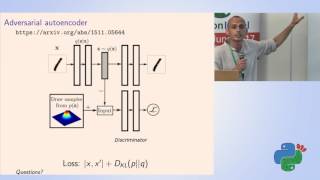
- 13:50Variational Autoencoder
- 14:37Variational Auto Encoder
- 18:36Anomaly Detection
- 29:40Import Tensorflow and Other Libraries
- 32:50Anomalous Ecg
- 33:23Build the Model
- 40:27Interactive Example
- 42:50Questions and Answers
related talks
 28mAnomaly Detection using Autoencoders
 28mPopulation Anomaly Detection with PyTorch
 26mAnomaly Detection System for the CERN Cloud
 45mVisual Regression Testing with Neural Networks
 41mApplying Foundational Models for Time Series Anomaly Detection
 28mHow Smart is the ECG? Lessons from Advanced ECG Analytics
 29mAnomaly Detection
 16mUtilizing The Power of Machine Learning in Healthcare