How Smart is the ECG? Lessons from Advanced ECG Analytics
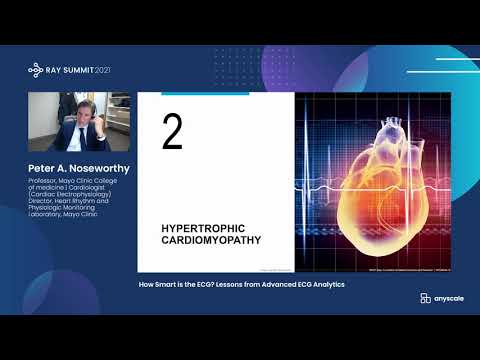
summary
A convolutional neural network trained on ~100,000 paired 12‑lead ECGs and echocardiograms detects low ejection fraction with AUC 0.93, hypertrophic cardiomyopathy with AUC 0.96, and predicts future atrial fibrillation with AUC 0.87. Automated reads match experts ~94% of the time (codes 85%). A randomized rollout across ~32,000 patients increases new low‑EF diagnoses (odds ratio 1.32, ≈5 extra cases per 1,000) and is integrated into the EHR and single‑lead stethoscope workflow.
AI-written summary · about
chapters (10)
- 0:00Introduction to AI in ECG
- 1:36Case study of AI utility
- 3:04Scaling and going beyond human
- 5:28Low ejection fraction detection
- 8:43Hidden insights in ECG data
- 10:55Hypertrophic cardiomyopathy
- 13:55Atrial fibrillation prediction
- 17:09Clinical trial validation
- 21:52The BEAGLE trial
- 24:49Future of clinical AI
related talks
 23mEngineering AI-Powered Predictive Healthcare Systems
 46mAnalyzing the ElectroCardioGram (ECG)
 07mCardiacWave: A mmWave-based Scheme of Non-Contact and High-Definition Heart Activity Computing
 17mTransforming Medical Records Into a Heart Attack Prediction Model
 45mAnomaly detection with TensorFlow
 04mBlack Box: How AI will Amplify the Best and Worst of Humanity
 20mMachine Learning in Cardiology
 18mCancer Screening using Deep Learning