A 24x Speedup for Reinforcement Learning with RLlib + Ray

summary
Migration from Stable Baselines to RLlib + Ray turns a CPU‑bound financial simulator into a 24x faster workflow: tests go from ~7–10 hours to ~2 hours on a single node (≈4x) and down to ~20 minutes when scaling across 16 machines (≈6x), yielding the reported 24x speedup. The win comes from avoiding the lockstep issue of vectorized envs by using batch rollouts with multiple rollout workers and inner vectorized envs, keeping the Gym API, adjusting a few hyperparameters via Tune hyperparameter search, and adding cheap commodity CPU nodes.
AI-written summary · about
chapters (12)
- 0:00Introduction to RLlib and Ray
- 2:49RL pipeline and bottlenecks
- 4:11Experiment challenges and initial attempts
- 7:20Migration to RLlib from Stable Baselines
- 9:03Benchmarking RLlib performance gains
- 10:45Parallelization types in RLlib
- 12:29Performance breakdown of steps
- 13:52Lockstep issue and its impact
- 15:37RLlib with Ray clusters
- 16:39Bonus features of RLlib ecosystem
- 17:43Conclusion and key takeaways
- 19:06Q&A
related talks
 28mScaling Multimodal Data and Reinforcement Learning with Ray
 20mEfficient Reinforcement Learning
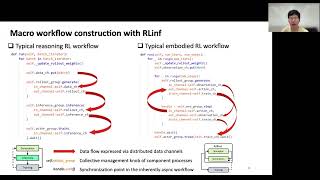 17mRLinf: Flexible and Efficient Large-Scale Reinforcement Learning...
 21mAdvanced Ray RLlib: New Features and New Possibilities
 30mTransforming Grab’s AI Platform with Ray
 17mScaling Reinforcement Learning
 33mReward Stress Tests for Agentic Post-Training with Ray
 29mRay:A Distributed Computing Platform for Reinforcement Learning