The hardest part of microservices: Your Data

summary
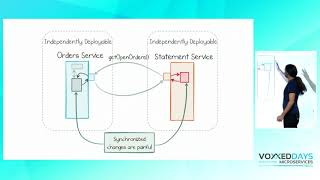
Explains how to stop juggling distributed transactions by capturing DB changes from the binlog and streaming them into Kafka so downstream services consume ordered, denormalized events; shows connectors for MySQL/Postgres/MongoDB, filters by schema/table, captures DDL and DML, can take a MySQL snapshot to bootstrap consumers, and integrates with schema registries and stream processors for search and caches. Practical demos use Debezium.io and Apache Kafka rather than two‑phase commit.
AI-written summary · about
chapters (42)
- 0:00Introduction
- 2:07Slide deck
- 2:34Christian Posta
- 6:02Adrian Cockroft
- 6:59Optimizing IT
- 7:46Optimizing for speed
- 8:14Managing dependencies
- 9:00What is data
- 10:19What is one thing
- 11:27Book example
- 12:32Domaindriven design
- 15:42Normalization
- 16:43Acid
- 17:39Comfort
- 17:57Issues
- 18:34We have to
- 19:04fully data centric
- 19:25what what
- 19:49data inside my service
- 20:24point in time snapshot
- 20:58call graph
- 22:41time
- 23:49reading data
- 25:26coordination
- 26:18microservices
- 26:44when things fail
- 27:49if youre not careful
- 29:16caching
- 30:07the cap theorem
- 31:44consistency
- 33:11baseball consistency
- 34:48relaxed consistency
- 35:25Strict consistency
- 36:08Manage the data
- 37:52The BGM
- 40:22How it works
- 42:24Cache catchment
- 43:19Bounded contexts
- 44:37Microservice architecture
- 46:11Demo Java EE
- 46:25Learnings
- 47:04Demo
related talks
 42mData Streaming for Microservices using Debezium
 15mManaging Data Consistency among Microservices with Debezium
 59mBuilding Data Intensive Microservices with Apache Kafka
 42mCreating event-driven microservices: the why, how and what
 48mIntegrating microservices by accepting the data dichotomy
 01h 05mMigrating to Microservice Databases: From Relational Monolith to Distributed Data
 33mMicroservices, Events, and Breaking the Data Monolith with Kafka
 55mThe data dichotomy: Rethinking data and services with streams