Eclipse OMR: a modern, open-source toolkit for building language runtimes
summary
Eclipse OMR extracts language‑agnostic runtime pieces from the J9 JVM and supplies a port layer, world‑class GC, a dynamic compiler and a JIT Builder for quick IL generation; the repo totals around 800k lines of code and receives ~5–10 commits/day. Mark‑sweep GC integrates in about GC hookup in <100 lines, Lua needs ~50 lines in the VM plus ~2,000 lines for a compiler prototype, and Ruby integrations run Rails and aim toward the “Ruby 3x” performance target; OpenJ9 is planned as an upstream Java repo.
AI-written summary · about
chapters (20)
- 0:00Intro
- 0:53Important Disclaimers
- 2:34And before anyone asks...
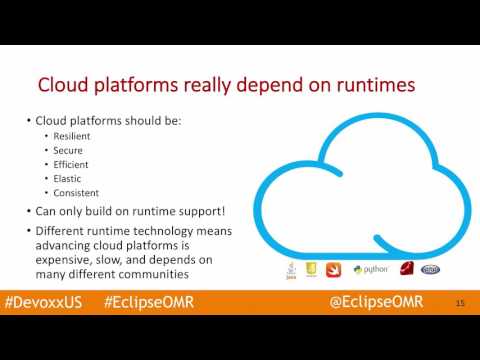
- 8:29Cloud platforms really depend on runtimes
- 9:31Eclipse OMR mission
- 13:07Form Eclipse OMR around core components
- 17:03Garbage collection technology
- 19:11What is Mark-Sweep GC?
- 20:10Hooking up the OMR Mark/Sweep Collector
- 20:52Compiler technology
- 25:18Hooking up a compiler via a native IL generator
- 26:28Hooking up a compiler via JITBuilder
- 28:18In the wild: IBM SDKs for Java
- 31:46OpenJ9 open source project
- 32:38Ruby
- 35:08Lua
- 37:18Base 9 (B9)
- 38:44What's next?
- 41:20Getting involved
- 42:24More Eclipse OMR in action
related talks
 34mIt's dangerous to GC alone. Take this!
 43mCreate your own Interpreter with a JIT in 1 hour
 48mOne VM To Rule Them All
 31mSimplifying and Optimizing Life on the Edge with Graal
 47mAdaptive Threading: The Goldilocks Dilemma with GC Parallelism
 50mOne VM to Rule Them All
 38mGraal
 40mNext Frontier in Open Source Compilers: Just-In-Time Compilation as a Service