Evolving Java for the Serverless Era with Micronaut

summary
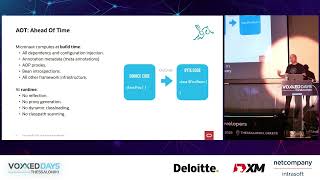
Micronaut uses ahead‑of‑time compilation to remove runtime reflection and proxies, generate bean introspection and HTTP client implementations at compile time, and provide a Jackson module to avoid duplicate reflective caches, resulting in much lower memory use and faster cold starts. Native images via GraalVM/Substrate produce examples starting around 15 ms startup (and a full app compiled there boots in ~35 ms), ordinary uber jars are ~11 MB, and some users report halving cloud costs.
AI-written summary · about
chapters (14)
- 0:00Intro
- 1:26Java's Problems for Framework Developers
- 8:15Why is Reflection a Problem?
- 9:55Avoid Reflection!
- 12:57With Micronaut You Can Build
- 13:51So What is Micronaut? Really?
- 17:34Micronaut and GraalVM
- 21:24Micronaut for Serverless
- 22:18Micronaut's Solutions
- 30:39Annotation Mapper
- 39:11ApplicationContext
- 39:36Configuration Properties Type Safe Configuration
- 46:40Micronaut Startup and Memory
- 48:53Summary • Micronaut Provides an Awesome Set of Framework
related talks
 46mDeveloper experience in a modern Java framework
 47mIntroduction to Micronaut Lightweight Microservices with Ahead of Time Compilation
 56mDeveloper experience in a modern Java framework
 45mIntruduction to Micronaut 2.0
 46mUnleash the power of your applications with Micronaut and GraalVM
 32mUnleash the power of your applications with Micronaut and GraalVM
 48mMicronaut Deep Dive
 55mUnleash the power of your applications with Micronaut and GraalVM