Developer experience in a modern Java framework
summary
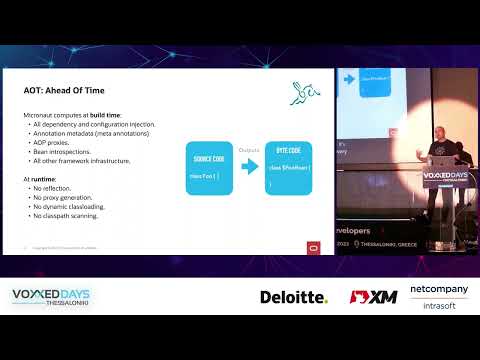
Micronaut claims and demos actual results: sub-second startup for a blank app (344 ms) and a GraalVM native image starting in milliseconds (16 ms), compile-time dependency injection and checks via Java annotation processing (no runtime reflection), compile-time validation of path variables, hot-restart (fast process restart) during edits, declarative HTTP clients sharing a Java interface so client and server fail to compile if signatures diverge, test runs that auto-start Postgres via Micronaut Test Resources and Testcontainers in ~2–3s (functional tests ~200 ms), bean replacement in tests, and built-in packaging to JAR, Docker, or native images.
AI-written summary · about
chapters (12)
- 0:00Introduction
- 2:30Micronaut overview
- 4:08Ahead-of-time compilation
- 7:42Technical architecture
- 10:12Building a controller
- 13:14Validation and configuration
- 17:37Dependency injection
- 22:20Testing strategies
- 27:16Client and mocking
- 32:38Database integration
- 37:23Packaging and deployment
- 40:20Q&A session
related talks
 56mDeveloper experience in a modern Java framework
 55mUnleash the power of your applications with Micronaut and GraalVM
 46mUnleash the power of your applications with Micronaut and GraalVM
 32mUnleash the power of your applications with Micronaut and GraalVM
 45mUnleash the power of your applications with Micronaut & GraalVM
 53mEvolving Java for the Serverless Era with Micronaut
 45mIntruduction to Micronaut 2.0
 44mUnleash the power of your applications with Micronaut and GraalVM