QWERTY or DVORAK? Debunking the Keyboard Layout Myths
summary
Research into original sources and a typewriter keymap heat‑map shows QWERTY is not designed to slow typists and the jamming story is at best inconsistent while telegraph operator tweaks are plausible. A personal experiment using online lessons and a six‑month typing log puts DVORAK at about 62 WPM after six months (≈75% of long‑trained QWERTY speed), reduces finger strain, and requires ~a year of practice to match prior throughput; slides and data live on SlideShare.
AI-written summary · about
chapters (10)
- 0:00Start
- 3:38Why Are the Keys on a Qwerty Keyboard Arranged in that Particular Order Is It To Slow Down Typists
- 5:56To Prevent Jams in Early Typewriters
- 6:33The Most Common Letter Combinations in the English Language
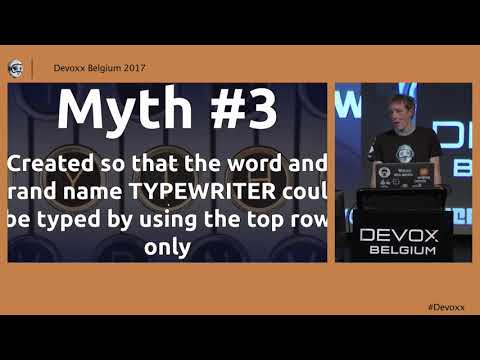
- 9:00The Word Typewriter Could Be Typed by Using the Top Row Only
- 10:04The First Typewriter
- 11:50The Doric Simplified Keyboard
- 13:14How Did I Try To Master Dvorak
- 15:58Should You Switch
- 17:04Keep Practicing Your Qwerty Skills
related talks
 23mIJQwerty: What Difference Does One Key Change Make? Gesture Typing Keyboard Optimization Bounded ...
 18mImproving Virtual Keyboards When All Finger Positions Are Known
 21mDualKey: Miniature Screen Text Entry via Finger Identification
 20mQuantifying Aversion to Costly Typing Errors in Expert Mobile Text Entry
 20mTipText: Eyes-Free Text Entry on a Fingertip Keyboard
 21mThe Impact of Word, Multiple Word, and Sentence Input on Virtual Keyboard Decoding Performance
 12mEvaluation of Korean Text Entry Methods for Smartwatches
 20mDriftBoard: A Panning-Based Text Entry Technique for Ultra-Small Touchscreens