Timestamping with opentimestamps
summary
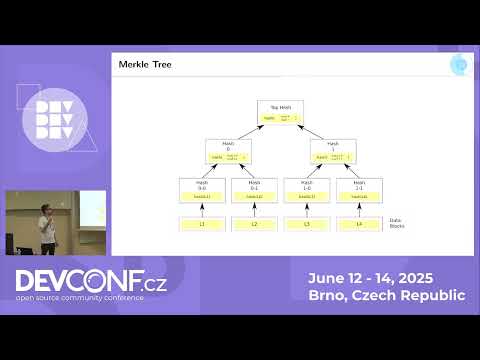
Claims that opentimestamps certifies a file’s existence date by embedding a Merkle root in a Bitcoin block so no central CA is needed and signatures can’t be backdated. It packs many stamps into one Merkle tree, produces a small proof file containing branch hashes so verification does not require a full node, and integrates with Git by append proof to GPG signature after commits/tags. Precision is block-level (hours), dozens of companies use it, and a prototype RPM integration exists and works.
AI-written summary · about
chapters (10)
- 0:00Timestamping introduction
- 1:11Digital timestamping challenges
- 2:20Blockchain for timestamping
- 3:04What is OpenTimestamps
- 4:12Merkle trees and scalability
- 6:00OpenTimestamps clients
- 7:09PGP revocation problem
- 9:07OpenTimestamps with GPG
- 10:41RPM packages use case
- 11:08Q&A
related talks
 01h 01mKey transparency: Blockchain meets NoiseSocket
 33mProject Origin - Granular Certificates - From Theory To Practice
 43mFinding the merkle tree in the block chain forest
 30mStateful Hash based Signatures: Practical Enhancements and Lessons learned
 01h 20mWhat are hash trees? and why you should care
 31mSecure Distributed Storage
 23mBlockchain
 19mAuthenticity Guaranteed: Verifying Video Integrity on Consumer Devices with Post-Quantum Signatures