Secure Distributed Storage

summary
Describes a concrete proof-of-useful-space pipeline: slow, CPU‑heavy initialization that encodes data into an incompressible replica using depth-robust graphs, commit the replica on-chain with a vector commitment, then repeat randomized audits by opening positions. Compares log n Merkle proofs (transparent, maintainable, heavy verifier work, good space‑time tradeoffs) versus algebraic/KZG schemes (aggregatable, trusted setup). Uses SNARKs to prove correct encoding — Groth16: 3 group elements, one pairing — and proposes a hybrid tree+algebraic VC that reduces some tradeoffs but does not yet achieve all desired properties.
AI-written summary · about
chapters (16)
- 0:00Start
- 0:10Storage Delegation
- 1:36Proof of space
- 9:18Binding Property
- 12:22Key Properties
- 14:02Subvector Openings
- 14:30Aggregation Updates
- 16:00Trade Space for Time
- 17:32Maintainability
- 17:51Space vs. Time
- 18:26State of the art
- 20:30No Aggregation
- 21:52Space Trade-off
- 23:41Hybrid Approach
- 26:41Overview
- 27:50What's next?
related talks
 01h 09mProofs - Practice 1
 52mFaster, Smaller, Weaker, Darker
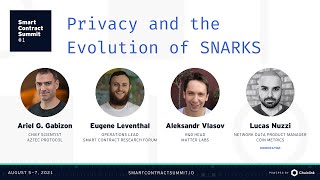 39mPrivacy and Evolution of SNARKs
 33mAn Introduction to Zero Knowledge Proofs
 23mSonic: Nearly Trustless SNARK Setups
 18mA Selection of Pairing Based zk-SNARKs
 25mGemini: Elastic SNARKs for Diverse Environments
 31mPrivacy-preserving smart contracts