Building a Sign-to-Speech Prototype with TensorFlow, Pytorch, and DeepStack

summary
End-to-end prototype converts live sign video to spoken words using TensorFlow, PyTorch and DeepStack, with a Nigerian Sign Language dataset (≈8,000 images, 5,000 after cleaning) from 20+ participants and diverse lighting conditions. Models tested include YOLOv5 and SSD for detection and MobileNetV2 classifier (fine‑tuned ~52 layers, trained ~150 epochs), achieving mAP@0.5 ≈ 0.95; output routes into a TTS engine. Major burdens are manual annotation, consent/privacy for faces, and constrained compute (Colab/ML Collective). Real‑time sign→speech pipeline (object detection → classifier → TTS).
AI-written summary · about
chapters (13)
- 0:00Introduction and speaker intro
- 1:03Project overview and motivation
- 3:38Project background and challenges
- 8:18Data collection and dataset creation
- 11:51Data annotation and preprocessing
- 13:18Model experiments and training
- 15:11Results and model evaluation
- 17:07Final model selection and tuning
- 19:18Deployment and demo
- 21:01Lessons learned and challenges
- 24:56Career insights and advice
- 27:45Balancing impact and personal growth
- 29:08Resources and closing
related talks
 26mBuilding a Sign-to-Speech prototype with TensorFlow, Pytorch and DeepStack: How...
 45mWhat if AI were the solution to understanding sign language?
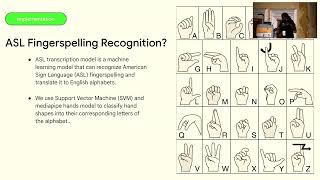 24mSIGN TO TEXT Unleashing the Power of Google AI for real time ASL transcription
 35mHow deep learning can help interpret American Sign Language
 01mEnabling Real-time Sign Language Translation on Mobile Platforms with On-board Depth Cameras
 09mBeyond Captions A Practical Pipeline for Live AI-Generated Sign Language Avatars
 16mMyoSign: enabling end-to-end sign language recognition with wearables
 27mThe Story of End to End Models in Deep Learning