Building a Sign-to-Speech prototype with TensorFlow, Pytorch and DeepStack: How...

summary
Claims a working real‑time sign‑to‑speech prototype that detects signs in webcam frames and emits spoken words, trained on roughly 8000 images from 20 people with faces blurred; models compared include YOLOv5, SSD (TensorFlow object detection API) and MobileNet classifiers (PyTorch experiments), with reported high detection scores (near‑99 on loose metrics, lower at mAP@0.95). Data labeling is manual (~5000 images annotated), deployment runs in Docker pointing to a DeepStack server with OpenCV for live capture and TTS conversion.
AI-written summary · about
chapters (15)
- 0:00Intro
- 0:57What is the project
- 5:27Lack of solutions
- 6:55Data
- 7:40Dataset
- 7:59Data Processing
- 8:28Experiments
- 9:36Results
- 10:48SD Model
- 11:26Classification Mode
- 13:01Matrix Table
- 13:45Deployment
- 14:04Demo
- 18:35Lessons learned
- 23:37QA Session
related talks
 30mBuilding a Sign-to-Speech Prototype with TensorFlow, Pytorch, and DeepStack
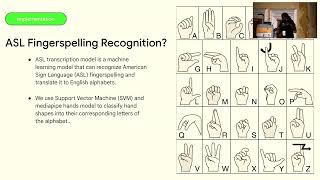 24mSIGN TO TEXT Unleashing the Power of Google AI for real time ASL transcription
 09mBeyond Captions A Practical Pipeline for Live AI-Generated Sign Language Avatars
 35mHow deep learning can help interpret American Sign Language
 40mKeynote: Open-source Multimodal AI in the Wild
 15mKeynote: Empowering Accessibility Through Kubernetes: The Future of Real-Time Sign Language Interpretation
 19mDocument Reader using Deep Learning with a Small Dataset
 01h 03mIt's All About AI