Architecting Agent Memory: Principles, Patterns, and Best Practices

summary
Architecture advice and concrete components for agent memory: a modular lifecycle of generation, storage, retrieval, integration, updating, forgetting implemented as distinct stores — persona, conversation, workflow, episodic, long‑term, toolbox and agent registry — backed by MongoDB as the memory provider that supports vector, text, graph and geospatial queries in one place. Practical patterns include storing JSON tool schemas in the DB and fetching relevant ones (OpenAI guidance: 10 to 21 tools in context), using embeddings plus re‑rankers to cut hallucination, and an experimental Memoriz library for patterns; prototypes are working but still experimental.
AI-written summary · about
chapters (12)
- 0:00Introduction and promise
- 1:51Evolution of AI systems
- 2:56What is an AI agent
- 3:57Why memory matters
- 6:03Agent memory fundamentals
- 7:29Memory management components
- 8:35MongoDB as memory provider
- 9:38Types of agent memory
- 13:32Memory tools and solutions
- 14:39MongoDB’s AI vision
- 15:41Neuroscience and AI inspiration
- 17:06Closing and Q&A
related talks
 47mAgents and Memory Architecture
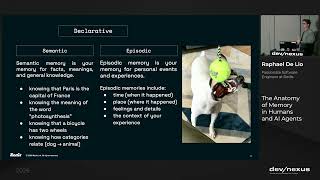 54mThe Anatomy of Memory in Humans and AI Agents
 01h 49mBuilding Memory Augmented Agents with MemoRizz
 46mDesigning Semantic Memory for Multi-Agent Systems with Python
 46mThe Anatomy of Memory in Humans and AI Agents
 21mBeyond Recall: Creating Agentic Personas with Persistent, Evolving Memory
 21mMulti-Agent Shared Graph Memory: Building Collective Knowledge for Agents
 58mAdvanced Autonomous AI Agents: Memory, Collaboration and Evolution in Action