Gaze-Driven Video Delivery: Science Fiction or Viable Link to the Metaverse?

summary
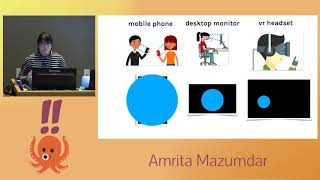
Gaze-driven delivery claims up to 500x pixel reduction for displays and even up to 8000x reduction for VR by encoding a 1° foveal patch instead of full frames, but derives a concrete delay–savings equation: 33 ms → ~3° ROI, 66 ms → ~5° ROI, 500 ms → ~31° (no gain). Practical system uses device-to-gateway last-link with tile-based streaming plus a low-res full-frame base layer, requires ~30–60 ms round‑trip, frame rates ≫60 fps, no buffering or retransmits, and therefore only works locally rather than across long-haul networks.
AI-written summary · about
chapters (10)
- 0:00Gaze-driven video delivery intro
- 1:12Gerald's 1988 vision
- 1:55Human vision principles
- 5:01Pixel reduction potential
- 7:08Latency impact on gaze tracking
- 10:19Delay thresholds for viability
- 12:29Low-latency system constraints
- 13:54Pragmatic system architecture
- 16:39Metaverse potential
- 17:47Summary
related talks
 09mHow to Throw Out 95% of Pixels in VR, Without Anyone Noticing!!
 17mYuZu: Neural-Enhanced Volumetric Video Streaming
 27mHoloportation: Virtual 3D Teleportation in Real-time
 17mPath to Metaverse-ready Networks
 17mHolographic Video Calling
 17mMorphe: High-Fidelity Generative Video Streaming with Vision Foundation Model
 25mFirefly: Untethered Multi-user VR for Commodity Mobile Devices
 46mScience based Design Decision Making for Virtual Reality