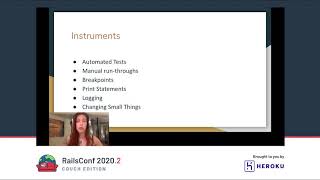
Getting Unstuck: Using the Scientific Method for Debugging

summary
Makes debugging a reproducible experiment: gather facts, pick one question, form a hypothesis, design a precise procedure, run it and record annotated logs. Uses notebooks, whiteboards, stickies or the text editor alongside logs. Concrete examples: a process that stalls for 52 seconds where healthy runs take 3–4 seconds because shelling out to node hits a node buffer limit and never flushes; swapping Ubuntu VM images with Packer and Chef causes a month of failures unless isolated and iterated.
AI-written summary · about
chapters (22)
- 0:00Intro
- 0:11Getting Unstuck: Using the Scientific Method For Debugging
- 0:25Who has ever gotten stuck while debugging?
- 0:49The Scientific Method Make your debugging a science experiment
- 6:12Gather Existing Knowledge
- 7:07Ask Questions
- 8:21Make a hypothesis An educated guess
- 9:03Design an Experiment
- 10:01Run the Experiment
- 11:43Come to a conclusion
- 12:30Circle Back
- 13:07Share what you learned
- 15:47Question: What part of the lifecycle is hanging? • Hypothesis: The sandboxed JS code is hanging
- 16:50Question: Maybe the data is too big • Hypothesis: When the data is too large, shelling out to node hangs
- 19:50Get teammates on the same page
- 20:55Good notes make it easier for your teammates to help you
- 21:13Writing down what you know helps organize your thoughts
- 22:05"How do I disprove this hypothesis?" is actionable
- 23:01Don't Repeat Yourself
- 24:46Each iteration moves you forward
- 25:28Story Time
- 27:21Two types of stuck