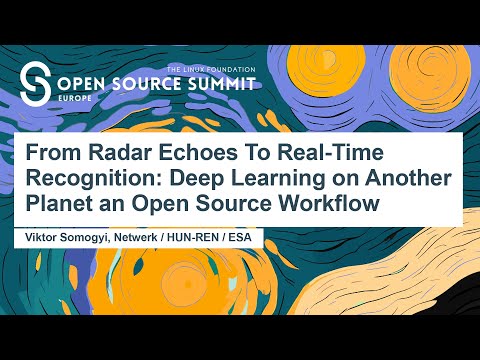
From Radar Echoes To Real-Time Recognition: Deep Learning on Another Planet an Open Source Workflow
summary
Real Magellan SAR mosaics (one file ~60 GB) convert to labeled training sets in QGIS, get cut into 512-pixel tiles, and train with PyTorch on AWS SageMaker containers using fixed seeds, MLflow/DVC logging and Docker for reproducibility. The pipeline measures precision/recall, runs false‑positive clinics, exports models to ONNX and outputs GeoJSON output and GeoTIFF layers after topology cleaning, yielding vectorized craters, domes and ridges that support crater‑count age estimates and reproducible science with a fixed random seed policy.
AI-written summary · about
chapters (10)
- 0:00Venus radar mapping project
- 3:15Venus mapping challenges
- 9:18Magellan radar mapping
- 15:22Radar mosaic images and distortions
- 22:14Radar echoes to geological layers
- 26:31Annotation to export workflow
- 34:25SageMaker training environment
- 37:45Model results and cleaning
- 40:17Scientific significance beyond Venus
- 43:12Open science applications
related talks
 31mFrom Radar Echoes To Real-Time Recognition: Deep Learning on Another Planet -An Open Source Workflow
 11mTerraKit: Standardising AI-Ready Geospatial Data...
 18mDeep learning for Space imagery applications
 01h 36mFrom Maps to Models: An End-to-End Journey in Geospatial Machine Learning with Python
 26mGeospatial Machine Learning at Scale
 28mAdvancing the future of space in the cloud
 41mPeer Beneath the Surface of the Earth
 48mAccelerate science, research, and innovation with AWS