Multi-Channel Bayesian Persuasion
summary
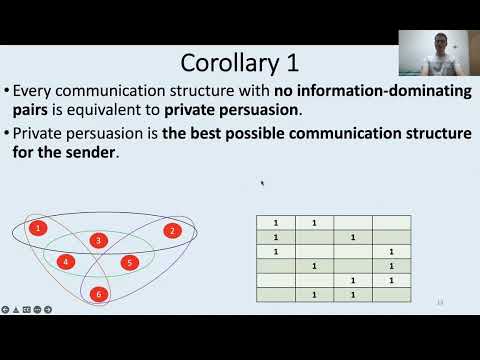
Main technical claim: a communication structure M1 always yields at least as much sender value as M2 for every prior and every utility profile iff every information-dominated pair in M1 is also present in M2 — a necessary and sufficient condition that fully orders structures. Consequences: any structure with no dominating rows is equivalent to private persuasion, and private schemes can be implemented with exponentially fewer channels. Proof uses secret-sharing encryption ideas plus Harsanyi’s universal type space. Algorithms: an additive FPTAS for forest structures with constant states and additive sender utility; hardness: computing optimum for separable supermajority utilities is NP-hard even with two states.
AI-written summary · about