Improved Decoding of Expander Codes
summary
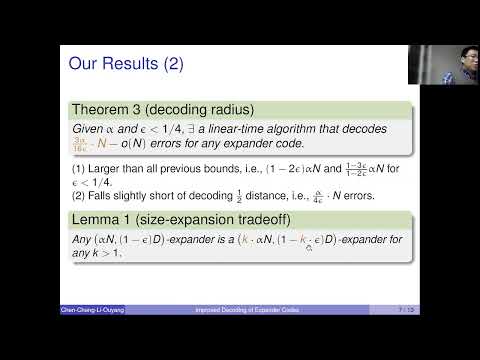
Proves a new worst-case distance lower bound for any expander code: distance ≥ αn/(2ε) (and shows this is tight up to constants). Gives a linear-time decoder that corrects up to 3αn/(16ε) adversarial bit errors for ε<1/4. Main technical tool is a size-expansion trade-off lemma: any k·αn subset has neighbor size at least (1−kε)d·|S|, proved by a collision/probability argument. Algorithm combines modified belief propagation (threshold tuning from the guessed expansion) with Viderman-style recovery.
AI-written summary · about
chapters (12)
- 0:00Intro
- 0:28Intro: Coding Theory Notations
- 1:26Intro: Expanders
- 4:19Intro: Expander codes
- 6:10More about Expander Codes Theorem 1 (Sipser-Spielman 96)
- 8:47Our Results (2)
- 13:09Rest of the talk
- 13:58Proof sketch for Theorem 2 (distance)
- 17:35Proof Sketch of the size-expansion tradeoff Basic idea: A probabilistic argument about collisions Lemma 1
- 21:19Ideas behind decoding radius Theorem 3 Given aand e=1/4-01 , 3 a linear-time algorithm that decodes N-ON errors for any expander code. Observation: Improve belief-propagation by guessing the expansion of the error set
- 23:21Summary: Expander Codes
- 24:30Discussion