Integrating Stable Diffusion Generative AI in Artist Workflows

summary
Uses the open-source pipeline centered on Automatic1111 + ControlNet with upscalers, hypernets and textual inversions/LoRA trained from ~10–20 images; runs comfortably on an i7-class CPU plus a GPU with high VRAM (Linux edges Windows). Builds iterative Photoshop ↔ Stable Diffusion loops that cut design time roughly 30–50% faster, produce full renders in a few hours each, and can generate ~500–600 reference images per day; fails at consistent multi-pose characters and game-ready animation without extra tooling.
AI-written summary · about
chapters (21)
- 0:00AI in artist workflows
- 1:03Why integrate Stable Diffusion
- 2:50Open source tools and hardware
- 4:35Building images with Stable Diffusion
- 5:58Prompt engineering importance
- 6:20Custom styles for generation
- 7:21Mixing AI-generated concepts
- 8:25Control Nets for composition
- 10:09Stable Diffusion and Photoshop
- 11:57Guiding with simple shapes
- 13:21Refining designs iteratively
- 14:47Depth maps for 3D control
- 15:51Typography and UI generation
- 17:18Full workflow example
- 18:21Time savings and pipelines
- 19:25Why artists need AI tools
- 21:16AI generation challenges
- 23:27Q&A: Animation consistency
- 24:31Q&A: Photoshop integration
- 25:17Q&A: Complex backgrounds
- 28:36Closing remarks
related talks
 25mDecoding Algorithmic Artistry: Visual Generative AI
 49mAstronaut Horse: Stable Diffusion Artist Collaborations
 50mWelcome to the Latent Dystopia
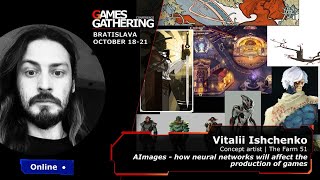 57mAImages - how neural networks will affect the production of games
 27mGenerative AI: What's Next?
 28mBeyond DALL-E: Advanced Image Generation Workflows with ComfyUI
 34mAdvancing Game Development: AI-Driven Asset Creation and Concrete Workflow Integration
 33mThe Dawn Of Universal Creativity