Project Leyden: Improving Java’s Startup Time

summary
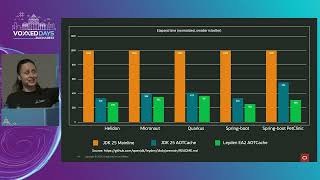
Project Leyden claims to cut Java startup time in half today and up to fourfold with future Java by shifting work into an aot cache created from a training run. The demo extracts a Spring Boot executable jar, uses class-data sharing and an AOT cache stored in the container image via buildpacks, and shows PetClinic falling from 3.2s baseline to ~0.8s cold start while preserving warmup (peak reached much faster) and combining Spring AOT+CDS yields ~20% memory savings.
AI-written summary · about
chapters (16)
- 0:00Introduction to Leyden
- 3:15Leyden goals and strategies
- 7:47JVM dynamism and circle of life
- 11:54Static vs dynamic phase transitions
- 18:47AOT cache and CDS technicals
- 23:01Spring Boot and Leyden
- 24:17Spring Petclinic case study
- 25:16Challenges with current CDS
- 26:55Self-extracting executable JAR
- 27:46CDS and AOT demo
- 29:34Performance and memory impact
- 30:34Buildpacks integration
- 32:10Retaining warmness
- 33:54Comparing technologies
- 34:51Conclusion and adoption
- 39:19Q&A
related talks
 42mSupercharge your JVM performance with Project Leyden and Spring Boot
 51mSupercharge your JVM performance with Project Leyden
 45mSupercharge your JVM performance with Project Leyden and Spring Boot
 41mSupercharge your JVM performance with Project Leyden
 43mStep up the performance game with Spring Boot and Project Leyden
 46mProject Leyden's AOT - Shifting Java Startup into High Gear
 45mFour Approaches to Reducing Java Startup Time: AppCDS, Native Image, Project Leyden, CRaC
 53mFour Approaches to Reducing Java Startup Time