Supercharge your JVM performance with Project Leyden and Spring Boot

summary
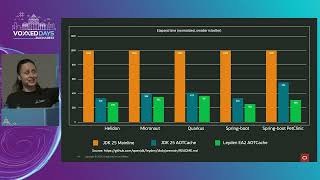
Project Leyden techniques plus Java 25 and Spring Boot cut a PetClinic startup from ~3.0s to ~0.8s using AOT cache (3.1x) and to ~0.075s with Spring AOT code generation (≈4x), while CPU startup cost halves and warm‑up finishes much sooner; training runs produce the cache (poorman’s run for class loading only, full integration/prod replay for method profiles), cache file must match JVM and flat classpath (extract fat JAR), and more aggressive Project Leyden prototypes show up to 5–7x CPU wins but need work on portability and JIT parity.
AI-written summary · about
chapters (12)
- 0:00JVM performance and Leyden intro
- 4:31Project Leyden goals
- 14:37AOT cache with Spring Boot
- 18:28Extracting Spring Boot jars
- 20:12Creating AOT cache file
- 22:58AOT cache vs Spring AOT
- 25:30AOT method profiling
- 28:17AOT cache vs native image
- 30:43Future of AOT in Leyden
- 36:50Spring AOT roadmap
- 38:36Boost startup with Java 25
- 39:19Q&A
related talks
 45mSupercharge your JVM performance with Project Leyden and Spring Boot
 51mSupercharge your JVM performance with Project Leyden
 41mSupercharge your JVM performance with Project Leyden
 43mStep up the performance game with Spring Boot and Project Leyden
 45mProject Leyden: Improving Java’s Startup Time
 46mProject Leyden's AOT - Shifting Java Startup into High Gear
 46mProject Leyden Update
 48mProject Leyden - Capturing Lightning in a Bottle