Supercharge your JVM performance with Project Leyden and Spring Boot

summary
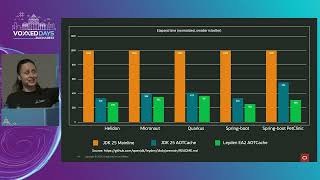
Project Leyden features in Java 25 via an AOT cache that records a training run (XXAOT mode record / XXAOT cache output) and speeds startup by preloading class linking and profiling. Extracting a Spring Boot fat JAR removes nested-classloader overhead (start 3s → 2.4s), adding the AOT cache and spring AOT drops time-to-first-request to ~0.6–0.95s (3x–5x improvement) while cutting CPU during startup ~2.6x; cache requires identical JDK/architecture.
AI-written summary · about
chapters (23)
- 0:00JVM performance with Leyden
- 1:27Talk goals and Leyden overview
- 3:34Java dynamic observation and JIT
- 5:58AOT cache in JDK 25
- 10:11Leyden vs GraalVM and others
- 11:33Demo: Pet Clinic startup time
- 13:39AOT cache with Spring Boot
- 15:45Extracting Spring Boot jars
- 16:28Training run with Spring Boot
- 18:32Demo: AOT cache with extracted jar
- 20:56Spring AOT benefits
- 22:44Demo: AOT cache + Spring AOT
- 24:11JDK 25 profiling improvements
- 27:20Leyden and JDK 26 next steps
- 29:05Demo: Leyden ahead-of-time compilation
- 32:34Leyden trade-offs
- 35:20Future Spring Boot improvements
- 37:26Summary and training runs
- 38:52Q&A: Cache deployment
- 40:02Q&A: Training run impact
- 41:29Q&A: Fast startup priorities
- 42:51Q&A: Leyden vs GraalVM/CRaC
- 44:55Closing remarks
related talks
 41mSupercharge your JVM performance with Project Leyden
 42mSupercharge your JVM performance with Project Leyden and Spring Boot
 51mSupercharge your JVM performance with Project Leyden
 43mStep up the performance game with Spring Boot and Project Leyden
 45mProject Leyden: Improving Java’s Startup Time
 46mProject Leyden's AOT - Shifting Java Startup into High Gear
 46mAssembling Project Leyden
 48mProject Leyden - Capturing Lightning in a Bottle