Assembling Project Leyden

summary
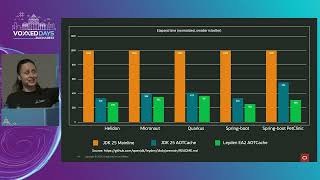
Project Leyden delivers JDK 24’s ahead‑of‑time class loading/linking and JDK 25’s method profiling, producing a workflow that creates an AOT cache from a training run (record → assemble → deploy or the combined output option); measured apps show 2–3× startup improvement on common server benchmarks. The assembly phase loads, links, resolves constant pool entries, builds the module graph and writes a durable primordial cache (class metadata + profiles, no arbitrary heap objects). Surprising learnings: the object heap is “toxic” for reuse and class initialization order easily causes nondeterministic behavior, so caches bind tightly to the build machine and must validate compatibility.
AI-written summary · about
chapters (8)
- 0:00Project Leyden intro
- 1:26Leyden's goals and startup
- 8:55Why assembly phase
- 14:16Assembly phase steps
- 21:17Recording observations
- 32:34Future Leyden directions
- 38:36Try Leyden today
- 39:46Q&A cache and reproducibility
related talks
 46mProject Leyden's AOT - Shifting Java Startup into High Gear
 41mSupercharge your JVM performance with Project Leyden
 23mAhead of Time Computation
 51mSupercharge your JVM performance with Project Leyden
 46mProject Leyden Update
 48mProject Leyden - Capturing Lightning in a Bottle
 45mSupercharge your JVM performance with Project Leyden and Spring Boot
 45mProject Leyden: Improving Java’s Startup Time