Why the Next Five Years Will Be About Languages

summary
Argues that the next five years center on new languages because per-core CPU speed plateaus push parallelism, virtual machines (JVM/CLR/WebAssembly) remove low-level plumbing, and modern tooling (ANTLR, Roslyn, CCI) makes language creation practical. Gives concrete wins: Emscripten -> Quake in browser shows transpilers + WASM work, Smalltalk’s ability to serialize running image demonstrates debuggable live systems, and service-first languages like Ballerina/Jolie prototype lower microservice cognitive load so teams can deliver production features faster.
AI-written summary · about
chapters (16)
- 0:00Introduction
- 2:19Programming language renaissance
- 4:07Practitioners vs academics
- 11:21Broken feedback loop
- 17:46Perfect storm of language research
- 19:09Virtualization and memory
- 24:26Modern language design tools
- 27:19Beyond object-oriented programming
- 32:47End of the free lunch era
- 36:37Unsolved problems in languages
- 37:21Service-oriented programming languages
- 40:54Lessons from Smalltalk
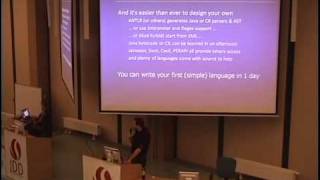
- 44:08Creating your own language
- 48:12Academic vs industry languages
- 53:09Convincing management
- 55:33Future of language-driven development
related talks
 01h 03mWhy the Next Five Years Will Be About Languages
 10mpart6 – Ted Neward
 10mpart3 – Ted Neward
 10mpart4 – Ted Neward
 57mWhy Programming Languages Matter
 56mThe Past, Present & Future of Programming Languages
 01h 10mThe Past, Present and Future of Programming Languages
 38mWhither Programming Languages: Where Did They Go And Where Are They Going?