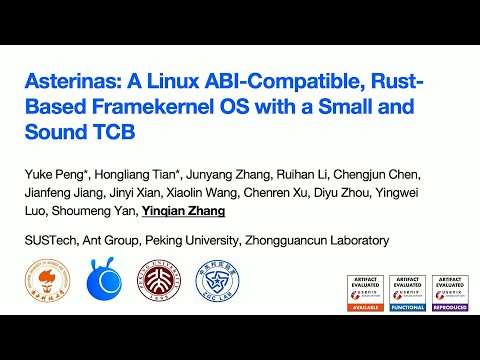
ASTERINAS: A Linux ABI-Compatible, Rust-Based Framekernel OS with a Small and...
summary
ASTERINAS is a Linux ABI–compatible OS implemented in safe Rust on a novel framekernel architecture with an OSTD crate that enforces intra-kernel privilege separation. It ships ~100k lines of Rust, implements over 210 Linux syscalls, runs on x86 and RISC‑V, supports ext2, virtio and USB, and boots on bare‑metal cloud and laptops. Measured performance is roughly 1.08× Linux on microbenchmarks, and the memory‑safety TCB is about 14.0% of linked code; Miri was extended to keri for UB detection and formal verification work is ongoing.
AI-written summary · about
chapters (8)
- 0:00Thrinus and ASTERINAS intro
- 1:01Research goals and Rust approach
- 3:30Frame kernel architecture
- 8:06TCB size and Linux support
- 10:58Performance vs Linux
- 13:05Undefined behavior detection
- 15:13ASTERINAS live demos
- 17:23Conclusion and Q&A
related talks
 27mRust in the Linux kernel
 34mWriting an Embedded Operating System in Rust
 24mRust for Linux: Status Update
 51mRust in the Linux kernel
 29m"10 Years of Redox OS and Rust"
 41mStatus of Embedded Linux
 39mFrom C to Rust: Bringing Rust Abstractions to Embedded Linux
 35mRUST Meets Embedded Linux: Build Memory Safe and Reliable Kernel Modules, Applications