Crocheting & Coding: they're more similar than you think!
summary
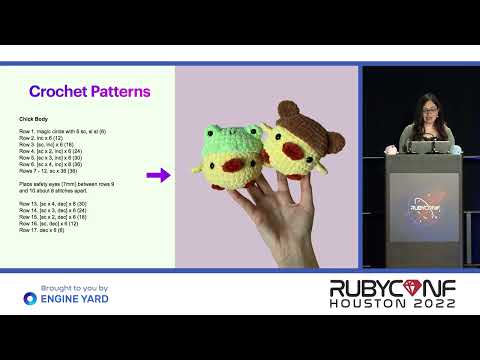
Claims that crocheting amigurumi maps to software development with concrete mechanics: crochet patterns have loops and syntax (Row 5 becomes a loop and conditional that calls increase or single‑crochet), stitch counts act as stitch counts as unit tests detecting failures, pattern testers serve as pattern tester = user acceptance testing, and refactoring turns a messy Pikmin draft into a clean published pattern. Tools listed are crochet hook yarn fiberfill and yarn needle; a simple frog takes ~3 hours to make while full pattern design can take ~12–15 hours; Ruby appears as the programming language example.
AI-written summary · about
chapters (13)
- 0:00Introduction
- 1:26Talk overview
- 3:50Crochet and coding background
- 5:15Designing in both
- 7:02Patterns as programs
- 9:07Loops in crochet and code
- 11:12Testing strategies
- 14:19Refactoring patterns
- 15:22Supportive communities
- 17:30Hobbies and career
- 19:54Teaching and mentoring
- 21:22Crochet resources
- 22:25Q&A
related talks
 27mProgramming with Yarn
 28mWeaving algorithms: the threads that bind the python and textile communities
 10mCrocheted! Computer! Graphics!
 29mA Foolish Quest: Creating Knitting Patterns Using JavaScript
 13mStitchFlow: Enabling In-Situ Creative Explorations of Crochet Patterns With Stitch Tracking and P...
 35mCoding: Art or Craft?
 28mExploring Self-Embedded Knitting Programs with Twine
 31mWeaving Tapestries of Code