Robust Learning of Stochastic Dynamical Systems

summary
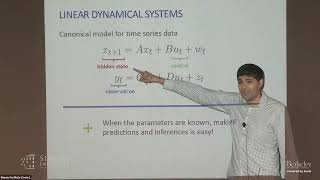
Claims a practical method to learn switched stochastic linear systems when mode labels are observed, producing a low-order approximation selected from the data by estimating the Hankel matrix from input/output rollouts and choosing a data-driven model order R via singular-value thresholding. Provides finite-sample bounds: parameter error scales with the estimated singular value ratio and decays roughly like estimation error ~ ns^{-1/4} in the number of experiments, and examples show very low orders (e.g. 4) suffice for 50k samples.
AI-written summary · about
chapters (13)
- 0:00Intro
- 1:21MIT INSTITUTE FOR DATA, SYSTEMS, AND SOCIETY
- 2:29System Identification: Finite Noisy data
- 3:24Switched Linear Systems
- 6:04Learning Setup
- 9:56Input-Output Data
- 11:18High Level Approach
- 18:32Issues with Hankel-like matrix
- 20:36Challenges and Solution
- 23:14Cut to the chase
- 24:15Recap
- 25:02LTI Example
- 26:29What's next
related talks
 43mLearning from Dynamics
 01h 01mRobustness, Stochastics, Uncertainty 1
 31mLearning to Control Unknown Systems
 01h 01mRobustness, Stochastics, Uncertainty 2
 01h 07mStochastic Second Order Optimization Methods I
 58mFirst-Order Stochastic Optimization
 01h 03mGeneralization from the behavioral perspective
 59mWhen do dependencies in your data help?