Generalization from the behavioral perspective

summary
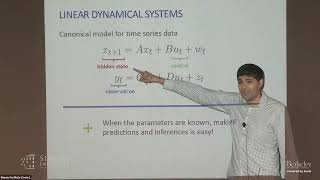
Argues that device and dynamical modeling treats a system as the set of all observable trajectories and that useful models are behavioral equations (kernel or latent representations) rather than vague topics. Gives a concrete recipe: for linear, time‑invariant, controllable circuits a single persistently excited trajectory produces a Hankel matrix whose column space reconstructs the system — the celebrated fundamental lemma — so one can extract state‑space equations; warns probabilistic IID assumptions (e.g., kernel interpolation or nearest‑neighbor guarantees) are pragmatic, not universally justified.
AI-written summary · about
chapters (12)
- 0:00Introduction
- 1:46Generalization mathematically impossible
- 3:30Behavioral modeling in EDA
- 8:47Device model desiderata
- 11:44Behavioral systems and models
- 18:15Data to models in identification
- 22:58Unfalsified models and falsificationism
- 30:00Problem of induction
- 36:40Material theory of induction
- 41:59Meehl's Lakatosian defense
- 50:25Behavioral systems and generalization
- 1:00:25Q&A
related talks
 43mLearning from Dynamics
 51mPlaying Newton: Automatic Construction of Phenomenological, Data-Driven Theories and Models
 31mInterpreting Machine Learning From the Perspective of Nonequilibrium Systems
 53mGeneralization insights from actual cognition
 33mRobust Learning of Stochastic Dynamical Systems
 42mSome Applications in Human Behavior Modeling
 51mThe Brain as an Efficient, Robust Adaptive Learner
 32mTheoretic analyses of internal model dynamics in the brain