Classifying Audio into Types using Python

summary
Uses pi audio processing in Python to extract specific features (MFCC, GFCC, spectral, chroma), train scikit learn SVMs and ship three pretrained classifiers. Small controlled experiments report concrete numbers: speech/music/birds with 50/train class yields MFCC test 13/14 music and 14/14 speech and birds; GFCC shifts speech to 12/14; combined matches MFCC. Location-name test trains on 23 female samples and tests 17 male samples with MFCC 8–9/17, GFCC 13/17, GFCC+spectral 15/17 and 14/17. Library also converts formats, trims silence, visualizes and supports auto hyperparameter tuning.
AI-written summary · about
chapters (29)
- 0:00Introduction
- 1:20About me
- 2:12Outline
- 2:36What is Audio
- 3:48What is Machine Learning
- 4:40Features
- 4:50Text Corpus
- 5:12Audio Features
- 5:31Spectrum and Kepstrum
- 6:34Visual representation
- 7:00Frequency domain
- 8:11Spectrum Kepstrum
- 9:18Gamma Tone Kepstrum
- 10:01GFCC Features
- 11:18Python Audio Processing
- 13:17Data Collection
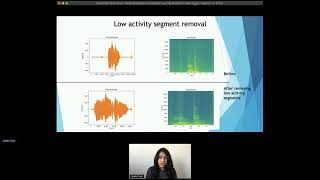
- 13:48Data Cleaning
- 14:34Questions
- 15:58Audio Classification
- 17:29GFCC Feature
- 18:05Comparison
- 18:18Combine
- 20:55Further Improvements
- 22:13Location Name Classification
- 22:53London Boston
- 23:22Experiments
- 24:43Results
- 25:24Resources
- 25:42QA
related talks
 40mBuilding Features and Machine Learning Models for Audio Signals
 11mClassifying Spoken Location Names
 40mGathering Insights from Audio Data
 29mRecognizing Speech in Python
 22mImplementation and analysis of deep learning models for speech classification
 25mLooking at Sound
 28mHow to use Deep Learning to process audio data and classify sounds.
 40mWho's singing? Automatic bird sound recognition with machine learning