Reinforcement Learning Without a PhD: A Python Developer’s Journey

summary
Claims a practical path: a supervised simulator learned from historical campaign data predicts next states so agents train with far less data, an ensemble gives uncertainty via ensemble disagreement to avoid risky actions, and a production stack (retraining pipelines, monitoring, Kubernetes) gets models into air. Built over 3–4 years, infrastructure another year, yielded a deployed marketing controller that cuts costs ~30%, removes repetitive work, and ships as the open-source Python package pi_optimal.
AI-written summary · about
chapters (13)
- 0:00Reinforcement learning excitement
- 1:31First RL demos
- 3:16Why RL excels beyond humans
- 5:01Real-world RL applications
- 8:10RL challenges in practice
- 10:16Building RL simulator
- 13:45Simulation-to-reality gap
- 15:10Prediction errors with uncertainty
- 17:19RL infrastructure challenges
- 18:41RL project results
- 20:05Practical RL pathway
- 21:29RL open-source tool
- 22:35Q&A
related talks
 37mImplementing Reinforcement Learning for Marketing Channel Optimization with Python
 26mHacking Reinforcement Learning
 01h 17mTraining intelligent game agents using deep reinforcement learning
 37mA practical perspective on training reinforcement learning bots.
 47mAdvanced Reinforcement Learning & Data Science for Social Impact
 31mDesigning game AI with reinforcement learning
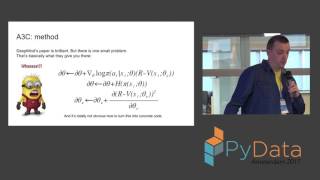 28mDeep Reinforcement Learning: theory, intuition, code
 01h 01mReinforcement Learning: Pac-Man