Using Causal thinking to make Media Mix Modeling

summary
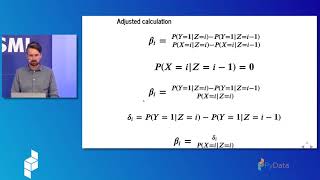
Shows a working pipeline that builds Bayesian structural media-mix models with PyMC and graph definitions in PyTensor, modeling adstock, saturation and experiment likelihoods. Demonstrates a concrete failure: a regression predicts ~10 user loss when a channel is switched off but an experiment shows ~600 lost users, and naive calibration fails to correct it. Uses DAGs to expose chains, forks and colliders, and argues for multiple targeted causal models rather than one monolith.
AI-written summary · about
chapters (27)
- 0:00Introduction
- 1:13What are media mix models
- 2:18From stats to causal MMM
- 3:20Model vs experiment disagreement
- 4:03Adding calibration to models
- 6:49Simulating data with PyTensor
- 9:18Building MMM in PyMC
- 10:01Key effects in MMM
- 11:05Model graph structure
- 11:49Model diagnostics and causality
- 12:31Causal effects with do-calculus
- 13:12Model vs real interventions
- 14:16Calibration with experimental data
- 15:58Why calibration alone is insufficient
- 16:20Pearl's theory and structures
- 17:02Total vs direct effects
- 18:08Collider bias in regression
- 19:12Adjusting for causal effects
- 20:15Aligning regression with experiments
- 20:36Key insights and takeaways
- 21:38Resources and further reading
- 22:00Q&A
- 22:41Q&A: Bad data handling
- 23:45Q&A: Causal structure learning
- 24:52Q&A: Causality book recs
- 26:15Q&A: Seasonal costs
- 26:57Closing remarks
related talks
 29mMedia Mix Modelling
 31mMedia Mix Modeling:How to Measure the Effectiveness of Advertising
 30mClimbing the causal ladder for fun and profit
 42mSolving Real-World Business Problems with Bayesian Modeling
 30mIs your marketing effective? Let Bayes decide!
 39mHow to Allocate Marketing Budget - Bayesian Approach to the Rescue
 01h 26mProbabilistic Programming and Bayesian Computing with PyMC
 17mThe causal problem of overexposure to repetitive ads: instrumental variables and pymc3