Big Brains, Small Targets: Whole-Brain Image Analysis with Python
summary
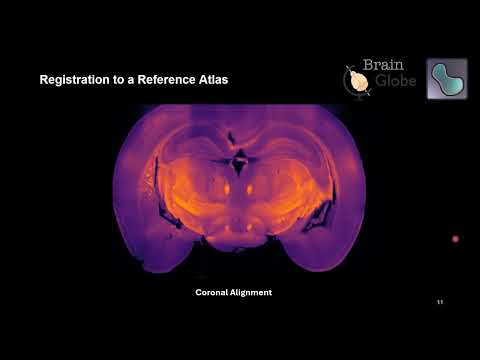
An end to end Python pipeline registers whole mouse brains to an Allen atlas with brainreg, scales processing of ~40 TB (20 brains) via dask and HPC, and segments TH+ neurons with a custom Cellpose model after parameter sweeps. Preprocessing (N4 bias correction, histogram matching) raises F1 scores and reduces per‑sample count shifts of hundreds of cells; consensus maps over parameter sets produce ranges of plausible neuron counts rather than a single brittle number.
AI-written summary · about
chapters (14)
- 0:00Whole-brain imaging with Python
- 1:06Project background and brain region
- 3:54Microscopy data challenges
- 6:39Python tools for brain registration
- 8:45Extracting SNPC with BrainGlobe
- 10:08Cell detection with Cellpose
- 11:33Registration inconsistencies
- 14:46Brain region registration challenges
- 15:52Manual ground truth annotations
- 17:14Parameter sweep and F1 score
- 19:01Pre-processing for registration
- 21:10Consensus maps for uncertainty
- 22:55Analysis pipeline and scalability
- 23:37Key takeaways
related talks
 48mNeural Networks and Brains
 29mWhat do a tree and the human brain have in common-a not so serious introduction to digital pathology
 58mStrong Generalization from Small Brains and No Training Data
 36mBrain's Neural Network as a service
 45mMachine Learning, Deep Networks and Interpretability in Systems, Cognitive and...
 30mCracking the code: neuronal networks in the brain
 20mCustom Python Applications in Neuroscience
- 20mCustom Python Applications in Neuroscience