Shipping your first Python package and automating future publishing

summary
Promises clear steps to get a package on PyPI in minutes and to stop doing it manually forever, showing concrete commands to build sdist and wheels, upload to test PyPI with twine upload, and verify with pip install, plus using setup.cfg instead of setup.py for safer metadata. Details include using API tokens (beta), classifiers (~600) and license options, automation with nox/tox and CircleCI to store CI secrets and publish from tags rather than local machines.
AI-written summary · about
chapters (29)
- 0:00Introduction
- 0:32Welcome
- 0:50About me
- 1:43Agenda
- 2:08Python Package Index
- 3:40Making a virtual environment
- 4:17Uploading to testpi
- 5:42Publishing to testpi
- 6:40Not using setuppi
- 7:46Setuppi warnings
- 8:17Python troves
- 10:41CFG
- 11:08Classifiers
- 11:55Dependencies
- 12:27Authentication
- 13:38API Tokens
- 14:19Resources
- 14:34Sample Project
- 14:55Cookie Cutter
- 15:44Automation
- 15:54Why automate
- 16:38Automation tools
- 17:58Unit testing
- 18:45Build documentation
- 19:16Circle CI
- 21:17CI jobs
- 21:57Deploy job
- 22:13Publish
- 22:51Stickers
related talks
 28mModern Python packaging without pain
 47mPublishing & Maintaining Opensource Python Packages in PyPI
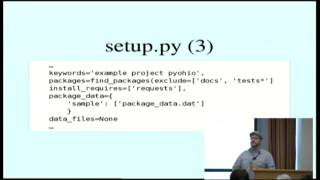 36mPython Packaging from Init to Deploy
 01h 21mSecure Python Packaging & Release Using Continuous Deployment
 45mStarting your project right: setup and automation for all
 22mPublishing well formed Python packages
 02h 36mPython Packaging Demystified
 24mInside the Cheeseshop:How Python Packaging Works