Stardust: Divide and Conquer in the Data Center Network

summary
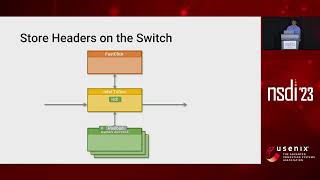
Stardust replaces multi-function fabric switches with simple cell switches in the fabric and richer packet-to-cell adapters at the edge, using scheduled traffic and dynamic cell routing to get nonblocking load balance. Cells are 256-byte cells, the fabric runs with a link-bundle-of-1 to cut tiers, and a NetFPGA prototype with packet packing reaches full line rate at 150 MHz while standard designs do not. Measured savings include 35% less power and ~66% less silicon area for fabric elements.
AI-written summary · about
chapters (6)
- 0:00Scalability challenges
- 1:13Network topology analysis
- 4:23Switch silicon limitations
- 8:33Optimizing switch utilization
- 11:11Stardust architecture
- 20:32Summary and Q&A
related talks
 19mStarfish: A Topology-Routing Co-Design for Small-Scale Data Centers
 17mCyberStar: Simple, Elastic and Cost-Effective Network Functions Management in...
 38mFacebook's Data Center Fabric
 19mDisaggregating Stateful Network Functions
 24mNetBlocks: Staging Layouts for High-Performance Custom Host Network Stacks
 23mBalancing on the Edge: Transport Affinity without Network State
 18mCStar Gateway: Augmenting Public Cloud Infrastructure for Heterogeneous Network...
 16mA High-Speed Stateful Packet Processing Approach for Tbps Programmable Switches