Encrypted Computation: What if Decryption Wasn’t Needed?

summary
Live demo encrypts a sentence with Zama on a Hugging Face space, runs an XGBoost inference and returns a decryptable neutral sentiment result, showing encrypted inference can work end to end. A Paillier Jupyter notebook demonstrates that multiplying ciphertexts yields an encryption of the sum — Paillier addition works — and secret sharing examples show MPC enabling joint computation without revealing inputs. Libraries and tooling mentioned: TensorFlow Encrypted / Moose, Zama concrete, Swift homomorphic encryption; caveats: heavy compute, Microsoft uses CKKS at scale and Intel/FPGA acceleration is often required.
AI-written summary · about
chapters (12)
- 0:00Intro
- 3:18What if...?
- 4:23Demo: Huggingface
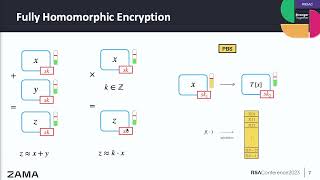
- 6:25Homomorphic encryption
- 8:41Pallier cryptosystem
- 12:12Demo: Pallier
- 15:22Recap
- 19:55Multi-party computation (MPC)
- 22:58Use cases
- 29:54Getting started with encrypted computation
- 32:45Understanding builds trust
- 34:01Outro
related talks
 37mOpen-source Machine Learning on Encrypted Data
 40mTrust No One
 52mMachine Learning over Encrypted Data with Fully Homomorphic Encryption
 44mIP Protection and Privacy in LLM: Leveraging Fully Homomorphic Encryption
 33mHomomorphic Encryption in the Open Source World
 47mTowards Confidential AI for the Masses!
 37mFrontiers in Cryptography
 44mIntroduction to confidential computing – protecting sensitive workloads