Progressive Web Apps: What, Why and How?

summary
Overview of practical PWA claims and tools: browsers now implement Progressive Web Apps features—Service Worker, Cache API, Fetch and manifests—so sites can cache, timeout flaky requests, and add to home screen. Demonstrations cite Ele.me (260M users, 1.3M listings), Trivago’s offline cache improving clickthroughs, Jio Cinema’s PWA showing ~10% longer sessions, mobile commerce worth $123B, average 3G page load ~19s. Workbox and Service Worker patterns handle complex caching; Workbox simplifies strategies; PaymentRequest speeds checkout; Lighthouse and AMP are recommended. 130,000 Indian training scholarships are available.
AI-written summary · about
chapters (13)
- 0:00Introduction
- 1:03Mobile web explosion in India
- 2:41Challenges for web developers
- 3:50History of the mobile web
- 6:02Importance of performance
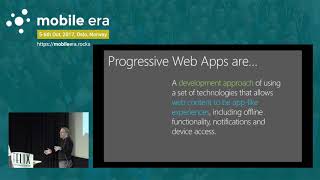
- 8:05What are PWAs?
- 10:31Browser support for PWAs
- 12:40Creating fast experiences
- 15:26Integration and payments
- 18:22Reliability and caching
- 21:12Case study and adoption
- 23:19Training and certification
- 25:59Conclusion and resources
related talks
 32mProgressive Web Apps
 53mProgressive Web Applications - The best of both worlds (App & Web)
 47mProgressive Web Apps
 38mProgressive Web Applications: The What, the Why and the How
 46mIntro to Progressive Web Apps
 37mIntro to Progressive Web Apps
 46mKeynote: Progressive Web Apps
 43mProgressive Web Apps - the Return of the Web?