Sampling Crash Course
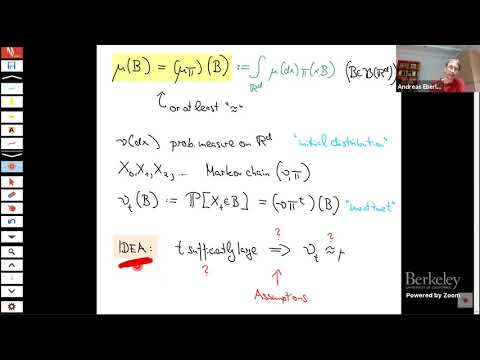
summary
Shows that random-walk Metropolis has exponentially small acceptance unless step size scales like O(1/d), uses conductance to turn that into provable lower bounds on mixing time, derives the continuous-time overdamped Langevin SDE with invariant density e^{-U} and characterizes invariant/detailed-balance drifts, proves synchronous coupling yields exponential W_p contraction under K-strong convexity, and introduces reflection coupling to exploit noise and obtain stronger (including total-variation) convergence controls.
AI-written summary · about
chapters (15)
- 0:00References
- 2:54Direct Methods
- 3:50Acceptance rejection
- 4:29Creating samples from mu
- 5:15Running time
- 7:07Markov chain Monte Carlo
- 13:05Mixing time
- 15:10Relaxation times
- 16:56probabilistic approaches
- 18:27analytic approaches
- 23:59Independent sampler
- 25:03Proposal kernel
- 27:19Random work metropolis
- 31:00Conductance
- 41:23Detailed Balance
related talks
 37mCorrelation Decay for Hard Spheres via Markov Chains
 31mInterpreting Machine Learning From the Perspective of Nonequilibrium Systems
 01h 02mContinuous Methods 1
 45mRandom Walks on Directed Graphs
 31mThe Convergence of Hamiltonian Monte Carlo
 58mTools from Stochastic Calculus 1
 01h 08mTutorial: Methods from Statistical Physics III
 46mRandom Walks on Simplicial Complexes and Isoperimetric Inequalities