Optimal Transport and PDE: Gradient Flows in the Wasserstein Metric

summary
Survey of specific PDEs that are Wasserstein gradient flows, the particle schemes used, and when they provably match the continuum: continuity equation with ODE particle limit; aggregation PDE with singular interaction potentials and empirical measures converging in Wasserstein metric; Fokker–Planck as gradient flow of V+entropy with stochastic particle methods converging almost surely; mean‑field two‑layer NN training is the gradient flow of the quadratic loss; chi‑squared flow gives a porous‑medium type PDE and is discretized by regularize with convolution to restore Lipschitz, then send regularization→0 and particles→∞.
AI-written summary · about
chapters (17)
- 0:00Introduction
- 0:55Motivation
- 2:03Continuity Equation
- 5:40PDE Properties
- 7:20Order of Convergence
- 9:11Aggregation Equation
- 10:35Dynamics
- 13:15Why PDE
- 15:07Grading flow
- 21:33Twolayer neural networks
- 25:43Chisquared divergence
- 29:05The plan
- 32:05What is perpendicular mean
- 33:44When do solutions exist
- 34:25Uniqueness
- 44:50Intuition
- 51:05Existence
related talks
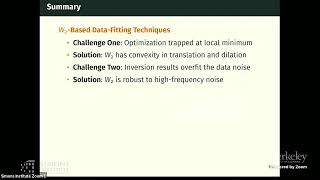 11mOptimal Transport for Inverse Problems
 54mExact Asymptotics and Universality for Gradient Flows and Empirical Risk Minimizers
 09mA Fast Algorithm for Optimal Transport
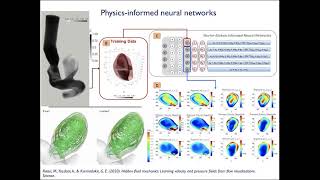 55mUnderstanding and Mitigating Gradient Flow Pathologies in PINN
 15mGraphical Optimal Transport and Its Applications
 09mPrimal--Dual Optimization and Application to Sampling
 01h 00mMin-Max Optimization from a Dynamical Systems Viewpoint
 45mPolicy Gradient: Optimal Estimation, Convergence, and Generalization beyond Cumulative Rewards