Crash Course on Optimal Transport (continued)

summary
Defines gradient flow on a Hilbert space by matching differential and gradient through a chosen inner product and shows the Dirichlet energy’s L2 subdifferential is −Δu, so its gradient flow is the heat equation. Derives the Benamou–Brenier formula: W2^2 is the infimum of the action ∫∫ |v|^2 ρ dx dt subject to the continuity equation. Optimal v is ∇ψ solving a Neumann elliptic problem, which yields the W2 scalar product and the rule gradW2 F = −div(ρ ∇(δF/δρ)). Dirichlet energy and entropy give the heat flow.
AI-written summary · about
chapters (10)
- 0:00Start
- 0:07Guardian Flows
- 1:22Gradient Flow
- 7:06Define a Gradient Flow
- 16:54The Dirichlet Energy
- 20:48The Differential Structure on the Space of Probability Measures
- 23:34Associate a Flow to the Vector Field
- 24:17How You Define the Vector Field inside the outside the Boundary
- 26:58Definition of Action
- 28:22Venomous Formula
related talks
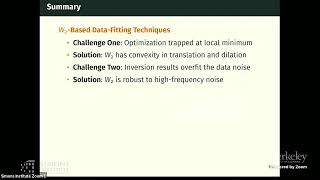 11mOptimal Transport for Inverse Problems
 09mA Fast Algorithm for Optimal Transport
 15mGraphical Optimal Transport and Its Applications
 54mExact Asymptotics and Universality for Gradient Flows and Empirical Risk Minimizers
 48mSketching Techniques for Kernel Density Estimation or for Optimal Transport Computations
 56mSome Probabilistic Uses of Dirichlet Eigenvectors
 55mUnderstanding and Mitigating Gradient Flow Pathologies in PINN
 53mConnection Laplacian, Hodge Laplacian, and Tensor Laplacian of a Graph