Crash Course on Optimal Transport

summary
Covers Monge vs Kantorovich formulations and shows that Monge maps can be empty while Kantorovich couplings always exist, because Kantorovich turns transport into a linear program with convex marginals. States Kantorovich duality and the simple dual for cost |x−y|: a supremum over 1‑Lipschitz potentials. Proves Brenier (called Wren) for quadratic cost: if mu is absolutely continuous then the optimal coupling is unique and equals a map T = ∇φ with φ convex. Defines p‑Wasserstein, geodesics via linear interpolation and constant‑speed property.
AI-written summary · about
chapters (10)
- 0:00Introduction
- 3:25Brief overview
- 8:28Cost formulation
- 12:13Applications
- 15:45Definitions
- 20:01Question
- 31:36Structure
- 35:37Optimal Coupling
- 50:04Moment Condition
- 56:14Optimal Transport Map
related talks
 15mGraphical Optimal Transport and Its Applications
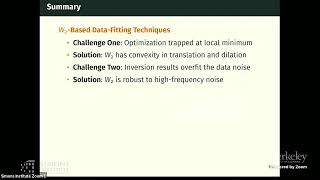 11mOptimal Transport for Inverse Problems
 09mA Fast Algorithm for Optimal Transport
 33mA Few Connections Between Optimization and Probability
 48mSketching Techniques for Kernel Density Estimation or for Optimal Transport Computations
 49mMetric Representations: Algorithms and Geometry
 01h 12mA Brief Introduction to Algorithms, Game Theory and Risk-Averse Decision Making
 48mSpatial Coupling as a Proof Technique