Category Theory: You Already Know It
summary
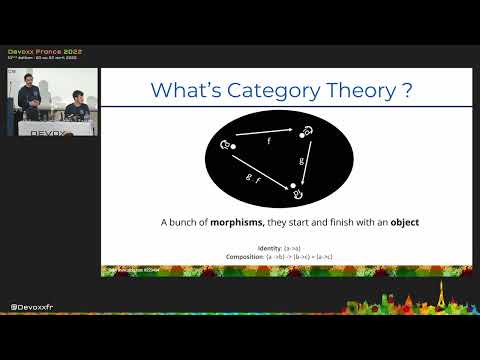
Explains how category theory concepts already appear in everyday coding using C# (and F#-style) examples: a banking micro-example filters suspicious account lines and sums Amount values using an Amount type and Status enum to avoid primitive obsession. Implements Maybe/Result types and functions like map/select, bind/SelectMany and flatten to compose partial or side-effecting steps, and demonstrates monoids (Amount addition with zero, string/list concat) with unit tests verifying identity and associativity.
AI-written summary · about
chapters (13)
- 0:00Category theory for devs
- 12:11Category definition
- 25:43Morphism composition
- 38:21Abstraction vs info loss
- 50:59Identity and isomorphism
- 1:00:35Monoids in code
- 1:12:58Side effects and composition
- 1:22:14Q&A
- 1:37:03Functors
- 1:58:44Natural transformations
- 2:05:20Monads: side effects
- 2:31:59Monads: error handling
- 2:38:22Summary
related talks
 51mCategory Theory for the Working Hacker
 52mCategory Theory Through Functional Programming (part 1/3)
 57mApplied category theory and abstract algebra
 41mA Pragmatic Introduction to Category Theory
 01h 11mCategories for the Working Hacker
 40mA Pragmatic Introduction to Category Theories
 42mWhat did category theory do for us?
 56mCategory Theory Through Functional Programming (part 2/3)